

Introduction
Cyberattacks are getting faster, more automated, and harder to catch. A recent case documented by Anthropic — an actor it tracks as GTG-20006 — shows exactly how much has changed. Anthropic’s attribution is consistent with public reporting that links this activity to the Russian state-nexus group known as Midnight Blizzard.
What stands out about GTG-20006 isn’t a brand-new hacking technique. It’s that the attacker leaned on AI-assisted workflows to automate large parts of the intrusion — from reconnaissance and phishing through to persistence, command-and-control, and data theft.
That one shift breaks an assumption a lot of security teams still rely on: that a serious intrusion needs a large, skilled team working every stage by hand. Increasingly, it doesn’t.
Who Was GTG-20006 Targeting?
GTG-20006 focused on high-value government, military, diplomatic, and defense-linked targets. Reported targets include:
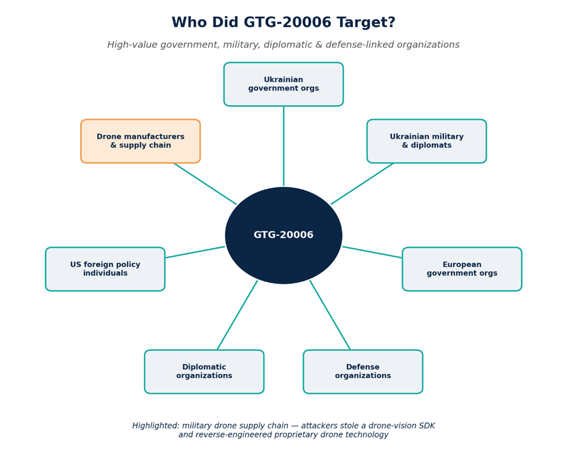
The campaign reached email and remote-access infrastructure across more than two dozen Ukrainian government organizations. One of the more notable targets was a military drone manufacturer — the attackers obtained access to mailboxes and reportedly stole a proprietary software development kit tied to a drone vision system, then spent time reverse-engineering it.
How Did AI Actually Change the Attack?
The core difference is automation, not innovation.
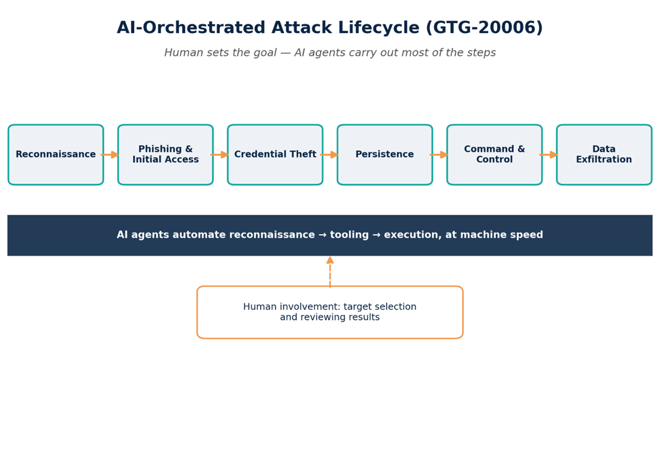
A traditional intrusion typically requires a human — or a team of humans — to manually work through reconnaissance, phishing, credential theft, persistence, lateral movement, data collection, and exfiltration, one stage at a time.
With GTG-20006, AI-driven workflows carried out much of that sequence. Humans stayed involved for the decisions that matter most — choosing targets and reviewing what the AI found — but the mechanical, repetitive work of scanning, tooling, and executing was largely delegated to AI agents.
In other words: AI doesn’t need to invent a new attack technique. It just needs to make existing techniques dramatically faster and more scalable.
What Did the Attackers Go After?
The operation worked through several layers of a victim’s environment:
- Email and remote-access systems — scanning government networks to find an entry point.
- User accounts and credentials — using credential-stealing tools aimed at browser password stores.
- Microsoft 365 and cloud identity — a device-code phishing setup built specifically to steal Microsoft 365 tokens from government and diplomatic staff, reportedly reaching mail records at multiple organizations.
- Internal data — once inside, the attackers searched for emails, technical documentation, credentials, and defense-related material.
- Drone technology — arguably the highest-value target. The group is reported to have obtained details on a drone vision system’s product architecture, hardware bill of materials, and supplier dependencies, and to have spent time reverse-engineering the stolen technology.
The Part That Should Worry Defenders:Self-Adapting Malware
Here’s where this case becomes a genuine turning point.
Historically, the malware arms race has looked like this: an attacker deploys a tool, a security product flags it, defenders write a detection signature, and the attacker goes back to the drawing board to modify the malware before trying again. Those back-and-forth takes time — time that usually favors the defender.
GTG-20006 reportedly used AI to compress that cycle. The AI monitored whether its own tooling was being flagged by security products, and when it was, AI agents could modify and rebuild the tooling — then try again — until it slipped past detection.
That loop (deploy → get detected → let AI rebuild → redeploy) can now run far faster than a human-only team could manage, and it puts real pressure on any defense strategy that leans mainly on static signatures.
Where Deception Technology Fits In
Most detection tooling asks a version of the same question: is this file, process, or connection malicious? That question gets harder to answer when the tooling itself keeps changing shape.
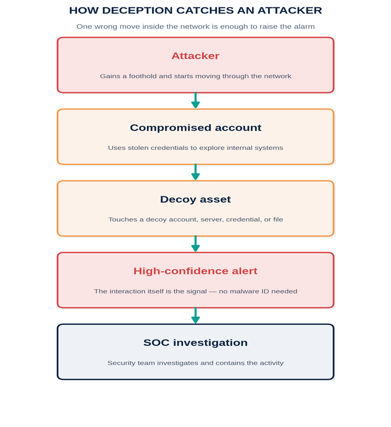
Deception technology approaches the problem differently. Instead of trying to fingerprint the malware, it places decoy assets inside the environment — decoy accounts, decoy credentials, decoy servers, decoy network services, decoy shares, decoy files, and fake privileged accounts — sitting alongside the real infrastructure. A legitimate user has no reason to touch any of these. An attacker doing reconnaissance often can’t tell the difference.
This doesn’t depend on identifying which malware variant is in use. Instead, it can flag the moment an attacker interacts with a decoy account, server, credential, or file — a much more durable signal than a hash or a static rule. The path is short and hard to miss:
Static decoys aren’t enough anymore
The catch is that a fixed set of decoys has the same weakness as a fixed set of signatures. An attacker working at machine speed can map an environment quickly, and decoys that never change are decoys that can eventually be profiled and avoided.
This is why Teacle Tech built i-Mirage as an AI-based deception platform rather than a static decoy deployment. i-Mirage analyses attacker behaviour as it happens — what the attacker is scanning for, which services they probe, which credentials they try — and reshapes the deception environment around that behaviour. If an attacker shows interest in file shares, the environment presents more convincing file-share decoys. If they’re hunting for privileged accounts, that’s what surfaces next.
The practical effect is that the decoy environment gets more believable the longer an attacker stays in it, instead of less. That keeps them engaged, generates richer telemetry for the SOC, and buys defenders time.
A Practical Defense Architecture
Put together, a reasonable architecture looks like this: a GTG-20006-style attacker phishes their way to a compromised account, then runs AI-assisted reconnaissance across the network. From there, the environment splits into real resources and deceptive assets. Any interaction with the deceptive side — a decoy server, a honey credential — fires an alert straight into the SOC/SIEM pipeline, kicking off investigation and containment.
This gives defenders another detection layer sitting inside the attack path itself, rather than depending solely on perimeter defenses or malware signatures that an AI-equipped attacker can iterate past.
Final Thoughts
GTG-20006 highlights a practical challenge for defenders: detection mechanisms that rely heavily on known malware or static indicators become less effective when attackers can rapidly rebuild their tooling. Deception technology adds another layer by placing monitored decoy assets inside the environment. An interaction with a decoy account, server, or credential can surface reconnaissance or lateral movement that would otherwise be difficult to distinguish from normal activity.
The more durable version of that defence is one that adapts. Teacle Tech’s i-Mirage uses AI to read attacker behaviour and reshape the deception environment around it, so the decoys stay convincing as the attack progresses rather than becoming easier to spot. If attackers are using AI to move faster, the detection layer they run into needs to be capable of the same.
Sources
- Anthropic — Detecting and Countering Misuse of AI: September 2026
- Reuters — Anthropic disrupts Russian hacking and other AI misuse
This post is for informational and educational purposes. Details of the GTG-20006 campaign are drawn from Anthropic’s published threat intelligence and independent reporting on the same report.
Comments are closed